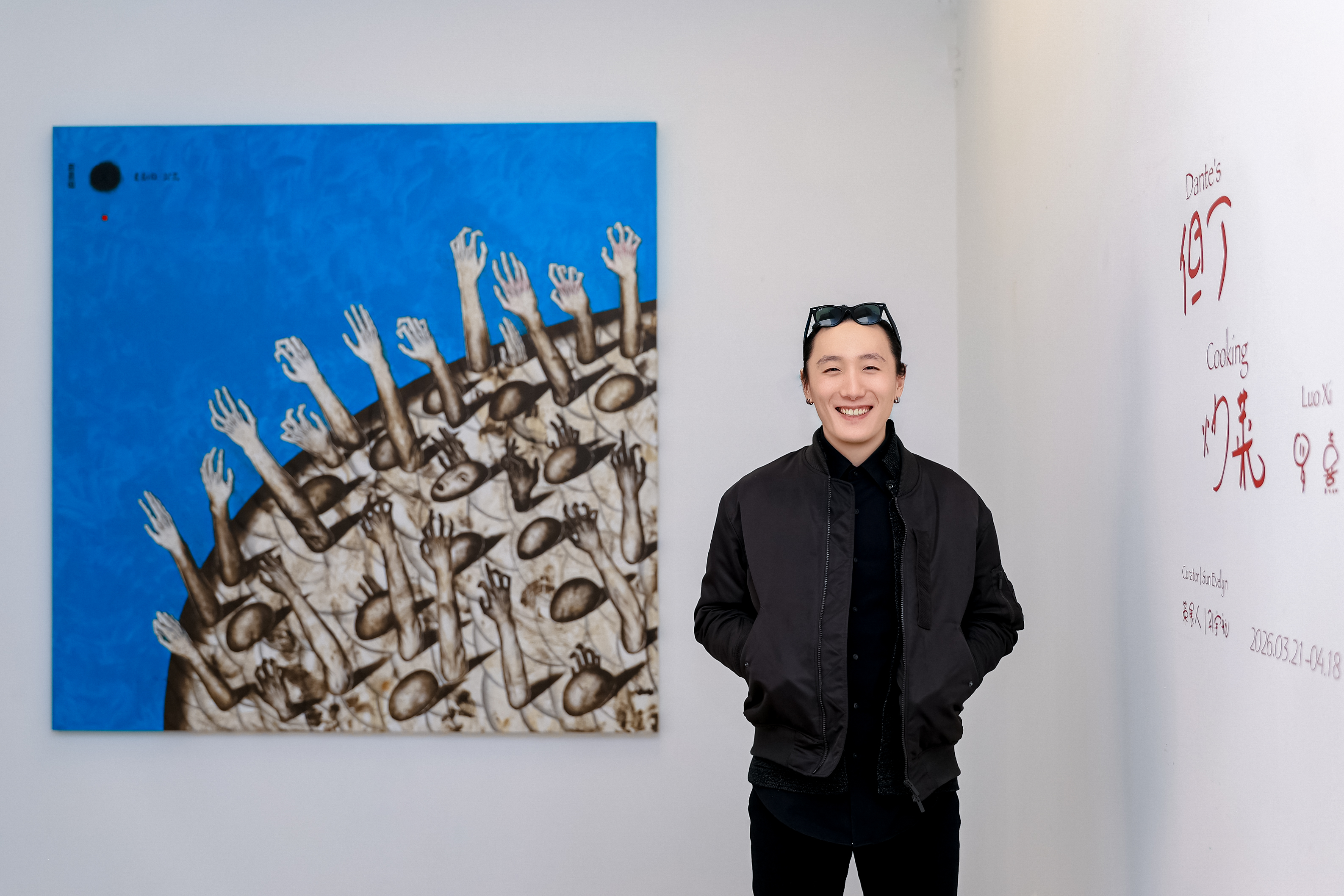
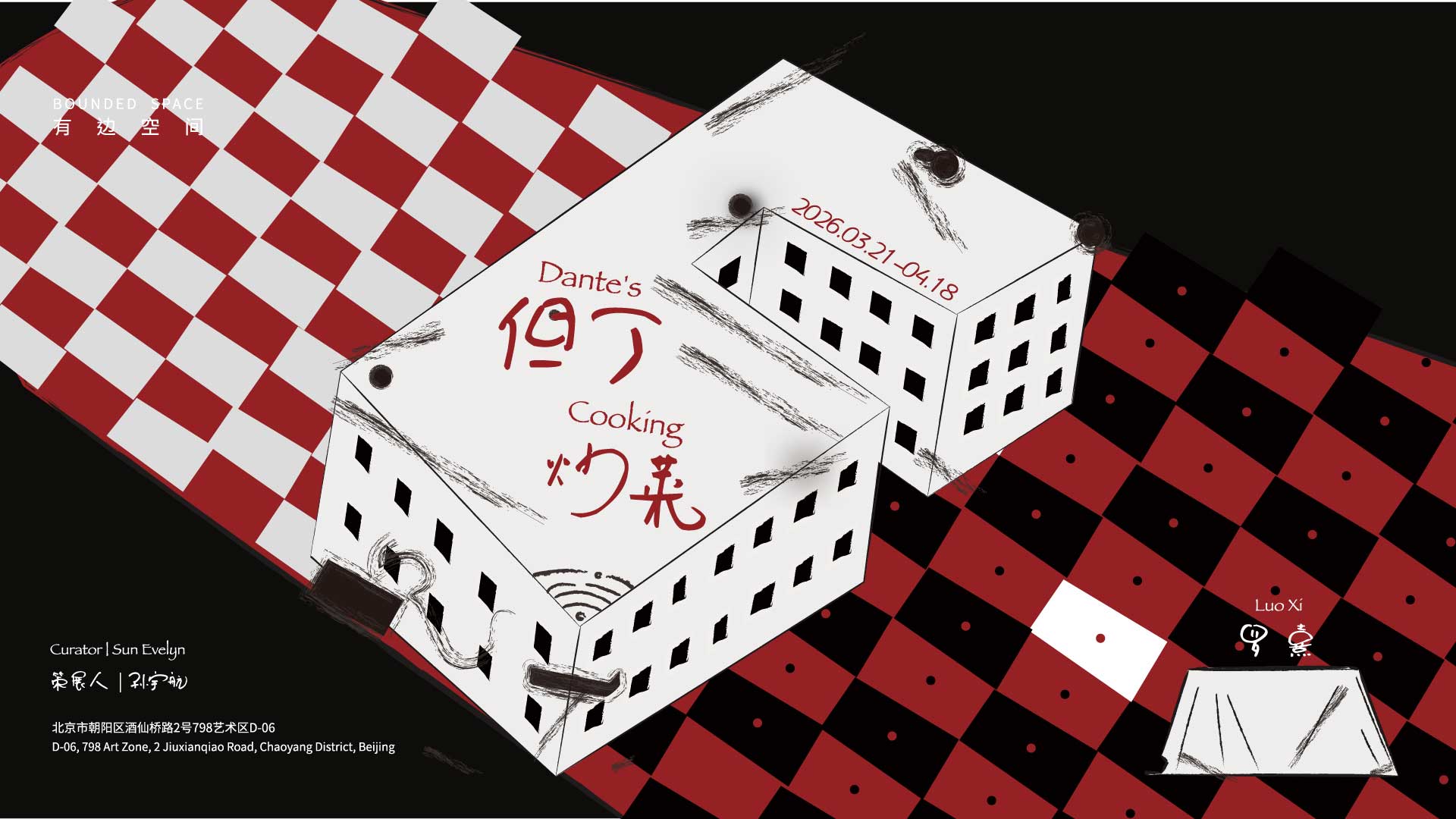
BOUNDED SPACE is honored to announce the solo exhibition of Luo Xi — Dante's Cooking, opening on March 21st. Curated by Sun Evelyn.
Foreword
Dante was writing about the human world.
In the 14th century, amid the prelude to the Renaissance, Dante was exiled from his native Florence following a bitter political struggle. It was during this long, wandering displacement that he composed The Divine Comedy. His Hell, Purgatory, and Heaven were not mere fantasies; they were visceral reflections of a chaotic and tragic reality. Finding himself "astray in a dark wood," Dante was documenting the world he had witnessed with his own eyes, rendered through a startling, haunting lens.
Luo Xi has undergone his own cultural "migration", re-scribing the contemporary world through a deeply personal vernacular. In 1999, as a young child, he moved with his parents to St. Petersburg, Russia. Unlike the surging modernization of post-reform China, the Russia of that era was reeling from the collapse of the Soviet Union. Old monoliths had fallen; a new order waited atop the ruins. In this vacuum of systemic failure and street-level volatility, a cold, frenetic foreign landscape became the foundation of Luo Xi’s creative consciousness.
The reconstruction of a "New World" is always fraught with labor pains. Within shifting structures, the human form is often distorted and alienated; the gray fissures of daily life become breeding grounds for the uncomfortable shadows of human nature. When confronted with such stark reality, romanticization feels needlessly cruel, yet traditional realism feels too heavy—solemnity cannot always cancel out sorrow, and can instead invite a paralyzing nihilism.
Thus, playfulness—or parody—emerges as a viable middle ground. For Luo Xi, parody is a contemporary stance for facing the world. Much like Dante abandoned the elite Latin of the upper classes for the common Tuscan dialect, Luo Xi rejects polished artistic pretension. He draws instead from a "secular" lexicon of violent aesthetics and blunt, curious symbols to remap our imagination of the present. Using The Divine Comedy as a narrative framework and "cooking" as his central metaphor, Luo Xi employs his signature techniques—reverse perspective, symbolic collage, and structural deconstruction—to juxtapose the sacred with the profane. In his hands, the circles of Hell are reimagined as "spiritual dishes": absurdity is the appetizer, desire is the main course. Everything solid, holy, or agonizing is tossed and deconstructed in a stir-fry of secular symbols, exposing the nakedness of humanity and the absurdity of the real.
However, this playfulness is not an escape from pain, but a transcendence of it. King Solomon once said there is nothing new under the sun. The human world of the 14th century and our own are not fundamentally different; history continues to rhyme. Yet, while we cannot choose the world we inhabit, we can choose the posture with which we face it. On the eve of the Renaissance, Dante wrote a masterpiece. In our unfinished contemporary moment, the "Dantes" can be found cooking. Who "Dante" is matters less than the new narratives being forged. Perhaps the most intriguing question remains: how will we choose to face the world today?
By Pang Yujing
Luo Xi born in 1994 .moved to St.Petersburg,Russia for living and studying from1999 to 2021.He earned his master’s degree in oil painting from the Repin Academy of Fine Arts in 2018 and his Ph. D. in art history from the same institution in 2021.Currently,he works and lives inBeijing.
Exhibition
2017 Solo Exhibition of Oil Paintings and Sculptures by Luo Xi, Moscow, Russia
2018 Solo Oil Painting Exhibition, Embassy of Russia in China
2018 Solo Oil Painting Exhibition, Livadiya Museum
2019 Luo Xi Solo Exhibition Tour, Spb Art Gallery, Italy
2020 Fermentation, Art-Belarus Gallery, Minsk, Belarus
2020 Solo Oil Painting Exhibition, Zurich, Switzerland
2025 Three Solo Painting Exhibitions, Beijing
2026 Solo Exhibition, Kazan, Russia
2026 Art Joint Exhibition, Shenzhen
2026 Joint Exhibition of Excellent Works by Repin Academy of Fine Arts, Beijing