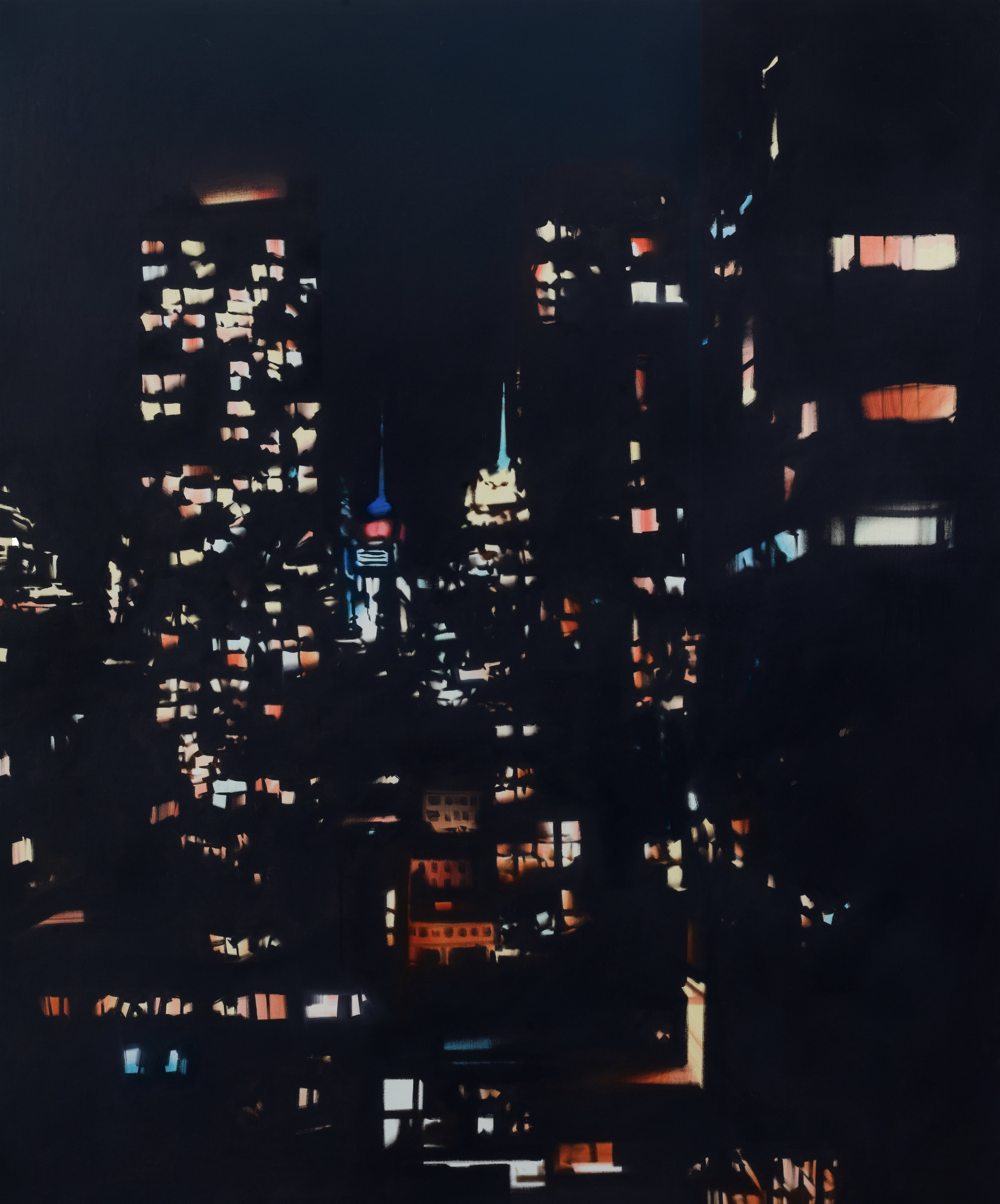
Night-3
Yao Peng has always regarded emotions as a kind of substance, perceiving their volume, energy, and form. His paintings unfold from images, like multi-track narratives. These whispers in the silence are accompanied by a sense of privacy, revolving around themes of loneliness, voyeurism, and the unnoticed passage of time. Yao Peng's creative inspiration often stems from the crevices and fleeting moments of life. His works represent a balance in the midst of vacillation. His creations more often seek psychological references: ambiguous, claustrophobic yet incredibly intense, making everything seem both ambiguous and distant. They can be seen from afar but cannot be truly reached. The images freeze at the moments just before an event is about to occur and at the points where words are left unspoken. Together with the suspended endings, they stretch out the psychological tension.
1984 Born in Jilin province China
2008 Bachelor's degree (Oil painting) Sichuan Fine Arts Institute, Chongqing, China
2012 Master's degree (Oil painting) Sichuan Fine Arts Institute, Chongqing, China
Lives and works in Beijing currently
His solo exhibitions include ”Dawn and Dusk”, (XZ Space, Beijing, 2025), “Fog of Time” (Enclave Contemporary, , Shenzhen, 2022), “Time Capsule” (Beijing Art Now Gallery, Beijing, 2018), “Ladies and Gentlemen” (Beijing Art Now Gallery, Beijing, 2016), and “Dedicated to the Living and the Dead“(Beijing Art Now Gallery, Beijing, 2013). His works have also been exhibited at institutions such as the White Rabbit Gallery (Sydney, Australia, 2022, 2014), HOW Art Museum (Zhejiang, China, 2019), Chongqing Art Museum (Chongqing, China, 2018), Museum Darmstadt (Darmstadt, Germany, 2016), Castello di Barbazzano (Florence, Italy, 2015), Himalayas Art Museum (Shanghai, China, 2014), Suzhou Art Museum (Jiangsu, China, 2013), and He Xiangning Art Museum (Guangdong, China, 2012).He was the recipient of the Luo Zhongli Scholarship in 2012. His works are included in the permanent collections of the White Rabbit Gallery (Sydney, Australia), Zhi Art Museum (Sichuan, China), He Xiangning Art Museum (Guangzhou, China), and Yuz Museum (Shanghai, China).